WE CONNECT YOU
The new network standard for IoT – Internet of Things
smartLoRa und LoRaWAN®

What is LoRaWAN® ?
LoRaWAN® stands for “Long Range Wide Area Network” and is a global wireless technology developed specifically for data transmission in the Internet of Things (IoT). This technology enables data to be transmitted from nodes (sensors, actuators) over long distances with minimal energy consumption.
Unlike conventional mobile networks such as GSM, which are high-frequency networks with high data density, LoRaWAN® offers a more cost-effective and energy-efficient alternative that is crucial for many useful applications in the IoT sector.
It enables the wireless networking of devices and sensors over long distances with low energy consumption and high security. LoRaWAN® is based on open and standardized technology that is supported by a large number of device manufacturers and network operators.
Depending on the environment and transmission power, LoRaWAN® has a range of up to several kilometers, making it particularly suitable for use in rural areas or industrial environments. Although the transmission speed is low compared to other wireless networks, it is sufficient for most IoT applications where reliable and energy-efficient data transmission is paramount.
At smartLoRa / CD-TELEMATIC GmbH, we rely on the advantages of LoRaWAN® and offer our customers a wide range of IoT solutions based on this technology. From monitoring plants and machines to smart control of energy and water infrastructures—with LoRaWAN®, there are virtually no limits to your application possibilities.
How does LoRaWAN® work ?
The Architectur of LoRaWAN®
LoRaWAN® networks are built on a cellular structure. A radio cell consists of a gateway that is connected to the network server via Internet access. The gateway provides the radio connection to the nodes and connects them to the network server.
The sensor data is evaluated and the actuators are controlled via an application server running on a PC, notebook, smartphone, or tablet. This flexibility allows for easy integration of various devices and applications.
Advantages of LoRaWAN®
- Low energy consumption: LoRaWAN® enables battery life of up to ten years, ensuring independent long-term operation of end devices. LoRaWAN® devices have low energy consumption, resulting in longer battery life and lower operating costs. This allows them to be used for applications that require long service life and high availability.
- Long ranges: The use of radio frequencies with longer wavelengths enables communication over several kilometers. LoRaWAN® enables data transmission over distances of several kilometers, depending on the environment and transmission power. This makes it particularly suitable for applications that require large coverage, such as smart city or Industry 4.0 applications.
- Scalability: LoRaWAN® supports a large number of devices, making it ideal for applications in agriculture, commerce, industry, and environmental protection.
- High security: LoRaWAN® offers high security for data transmission as it uses end-to-end encryption. This allows confidential data to be transmitted securely without being intercepted by unauthorized persons.
- Open standards: LoRaWAN® is an open and standardized technology supported by a wide range of manufacturers and network operators. This allows devices and infrastructures from different manufacturers to be interoperable, which increases flexibility and scalability.
- Low costs: LoRaWAN® infrastructures are relatively inexpensive to install and operate, as they do not require expensive cable or fiber optic networks. This makes them affordable even for smaller companies and organizations.
Applications
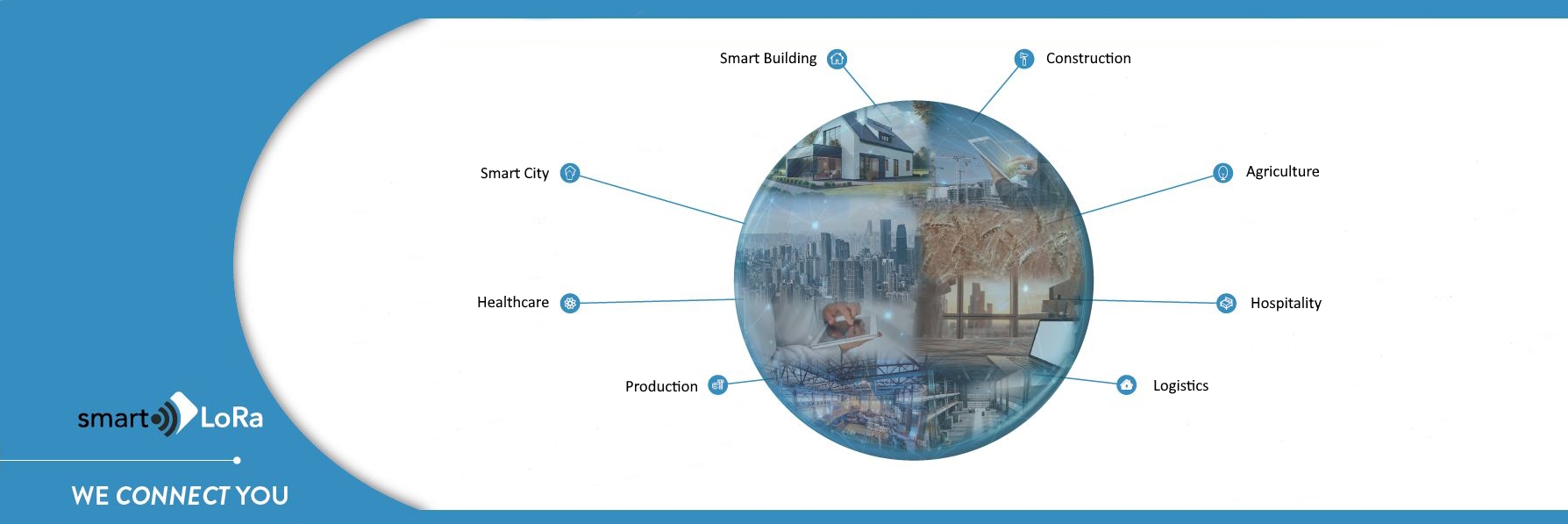
LoRaWAN® can be used to implement numerous applications in various areas. LoRaWAN® offers a wide range of possibilities.
It is a technology that is suitable for many use cases.
For example:
Smart City – Cities where public utilities, schools, roads, or parking lots are controlled.
Smart Building – Collection of real-time data for monitoring buildings.
Construction – Nodes and sensors can effectively monitor construction sites and collect important data.
Agriculture – Soil sensors can measure moisture levels, for example, and thus make irrigation more effective.
Hospitality – This technology has proven to be very useful in making operations more efficient and providing guests with a better experience.
Logistics – Monitoring inventory levels and controlling the flow of goods.
Production – Monitoring machines, controlling processes, and optimizing workflows.
Healthcare – Data on staff and bed utilization as well as room occupancy is collected and processed. This enables better planning and coordination.
As you can see, LoRaWAN® can be used in many different areas. You can read more about the examples mentioned here on this page under “APPLICATIONS.”
Now you have a brief overview of the possible applications of LoRaWAN®. For more information and further application possibilities, please contact us.